


Cyberphysical Systems, Imperial College London
Project: 'The Onion', 2019
The brief
"The Onion" project is a humorous and conceptual gadget born from the intention of exploring mechatronic systems capable of responding to environmental stimuli using Machine Learning. Developed in collaboration with Magdalena Popova and Qi Jingsong, this project was part of the Cyberphysical Systems module in the Innovation Design Engineering program.
The assignment required the development of a functional mechatronic prototype, driven by at least one self-created Machine Learning model.
The proposal
"The Onion" is a shoulder-worn wearable, humorously designed to start a conversation around the issue of unauthorized photography in the smartphone era.
This product features a series of robotic petals arranged around the neck like a necklace, along with a video camera positioned on the chest. When "The Onion" senses an attempt to photograph the wearer with a cellphone, the petals swiftly enclose the user's head, shielding their face from the camera. The device reopens once it detects that the risk of being photographed has passed.

The hand pose suggests an intention to take a picture!
→ Close the petals
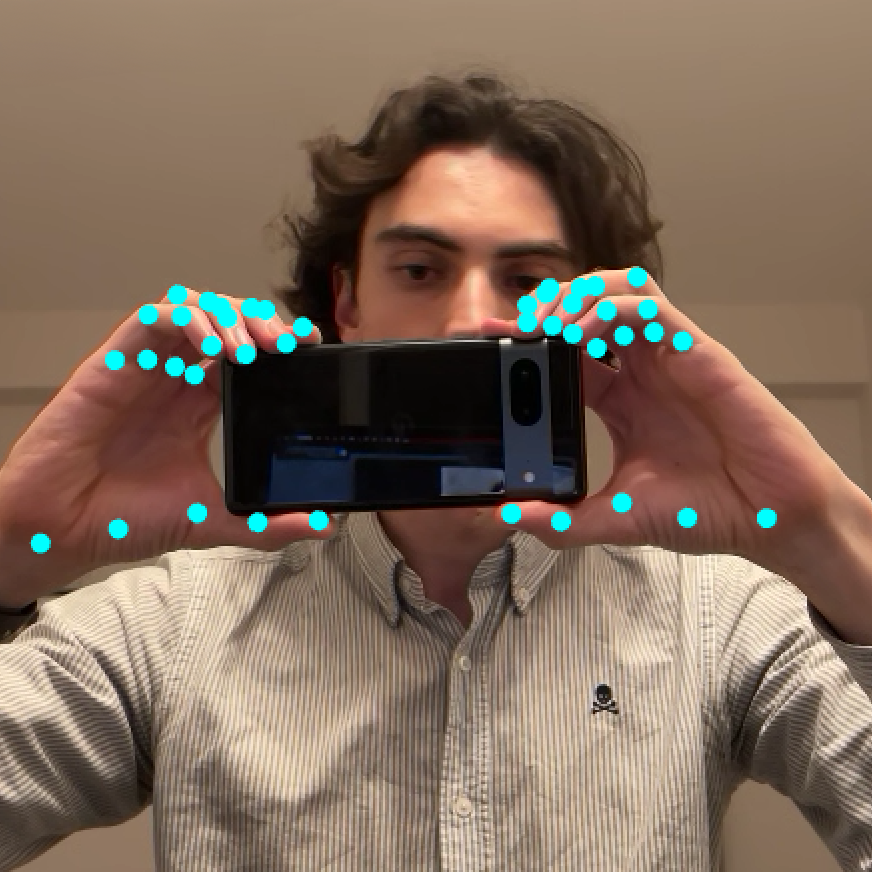
The pose does not signal the intention to take a photo
→ Open petals

Operation principle: Software
"The Onion" employs two sequential Machine Learning (ML) models to identify attempts to photograph the user's face.
First Model: Utilizing the Apple Vision Framework, this third-party-developed model converts visual data from the embedded camera into numerical coordinates. These coordinates represent the location and pose of everyone's hands within the camera's view.
Second Model: This is an in-house developed Support Vector Regression (SVR) model, crafted using Wekinator. It analyzes the hand coordinates to ascertain if any hand posture matches any of the distinct poses of holding a cell phone to take a photo. Upon detection, it signals a Processing script to promptly close the petals.
Testing the model: the red light indicates the presence of someone trying to take a picture.
Operation principle: Hardware
"The Onion" comprises three robotic arms, each powered by servo motors and orchestrated by an Arduino linked to a cellphone camera. When the Arduino receives a signal from the Processing script about an impending photo, it commands the servomotors to swiftly close the petals.
The petals are constructed from lightweight materials (PLA, papier-mâché, and nylon) to reduce the torque required for movement. Additionally, the lower joints incorporate a gear system to amplify the servos' torque, ensuring rapid petal movement.